Laichkraut
Laichkraut
Foto: Frank Vincentz

LAICHKRAUT
(Potamogeton sp.)

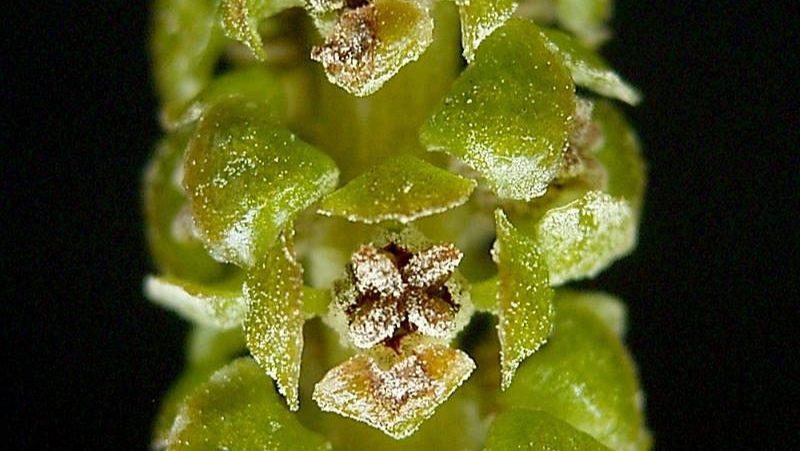
Die Laichkräuter sind Wasserpflanzen, die zur Gattung der Froschlöffelartigen gehören. Sie sind nahezu weltweit verbreitet, wobei die Vielfalt auf der Nordhalbkugel am höchsten ist. Die Evolution der Laichkräuter begann in Nordamerika und von der Nordhalbkugel haben sie in mehreren Wellen die Südhalbkugel besiedelt. Wissenschaftler gehen derzeit davon aus, dass es 80 bis 100 Arten gibt, wobei es oft zu Hybridisierungen kommt, was die Diversität erhöht. In Deutschland kommen etwa 21 Arten und 17 Hybride vor. In der Grube Messel kommen mit dem Schwimmenden Laichkraut (Potamogeton natans) und dem Krausen Laichkraut (Potamogeton crispus) mindestens zwei Arten vor. Weiterhin kann man Laichkraut auch gut im Teich am Bistro sehen. Auch vor 47 Millionen Jahren gab es im Messelsee mit Potamogeton speciosus eine Laichkrautart.

Die Laichkräuter gehören zu den wichtigsten Pflanzen in Süßwasserökosystemen, insbesondere was Nahrungsangebot und Habitate für wasserlebende Tiere angeht. Eine einzelne Pflanze bildet sowohl zarte Unterwasserblätter, als auch kräftigere Schwimmblätter aus. Letztere treiben wie Seerosenblätter auf der Wasseroberfläche. Die Blüten ragen zur Bestäubung aus dem Wasser.

PONDWEED
(Potamogeton sp.)

Pondweeds are aquatic plants that belong to the genus Alismatales. They are distributed almost worldwide, with the highest diversity in the northern hemisphere. The evolution of pondweeds began in North America and from the northern hemisphere they have colonized the southern hemisphere in several waves. Scientists currently assume that there are 80 to 100 species, with hybridization often occurring, which increases diversity. Around 21 species and 17 hybrids occur in Germany. At least two species occur in the Messel Pit: the floating pondweed (Potamogeton natans) and the curly pondweed (Potamogeton crispus). Pondweed can also be seen in the pond at the bistro. A pondweed species, Potamogeton speciosus, also existed in Lake Messel 47 million years ago.

Pondweeds are among the most important plants in freshwater ecosystems, especially in terms of food supply and habitats for aquatic animals. A single plant forms both delicate underwater leaves and sturdier floating leaves. The latter float on the water surface like water lily leaves. The flowers protrude from the water for pollination.

3D model created by Anthony J. Hayes at the Bioimaging Research Hub of Cardiff University’s School of Biosciences (Core facility RRID: SCR_022556) using methodology as described in  Hayes, A.J. (2017) Production of 3D Printed Scale Models from Microscope Volume Datasets for use in STEM Education. EMS Eng Sci J. 2017, 1(1):002. Copyright Hayes, A.J. 2017.