
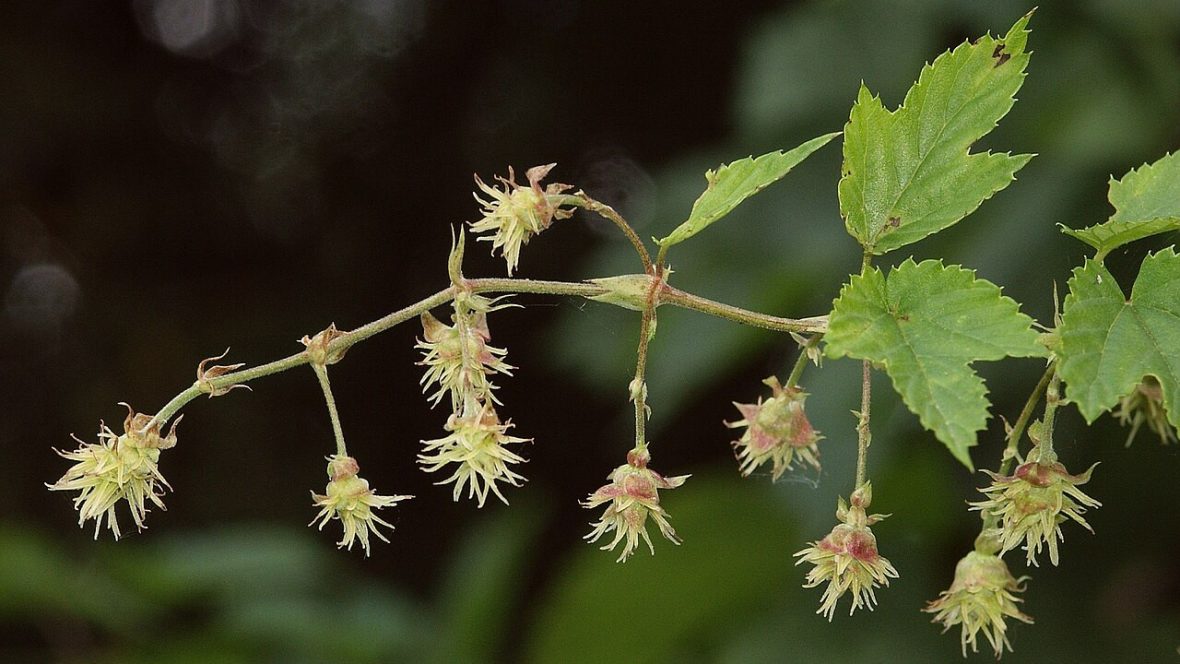
ECHTER HOPFEN
(Humulus lupulus)
Hopfen ist eine zweihäusige Pflanze, das bedeutet, es gibt eine männliche und eine weibliche Pflanze, was man an den Blütenständen erkennen kann. Die Bestäubung erfolgt in diesem Fall durch Wind und Insekten.
Der Echte Hopfen gehört zu der Familie der Hanfgewächse (Cannabaceae), die sowohl fossil als auch rezent in der Grube Messel gefunden werden. Bis heute ist er in Mitteleuropa heimisch.
Als Arzneipflanze wird der Hopfen schon sehr lange verwendet, seine schlaffördernde Wirkung ist wissenschaftlich anerkannt. Ebenso wird er gegen Appetitlosigkeit und bei Magenschleimhautentzündungen empfohlen.
Junge Hopfensprosse kann man braten oder kochen und Hopfenspargel wird als kostspielige Spezialität angeboten.
Hauptsächlich wird Hopfen bei der Bierherstellung verwendet, durch ihn bekommt das Bier sein Aroma und seine Bitterkeit. Es werden nur die weiblichen Hopfenpflanzen genutzt. Deutschland und die Vereinigten Staaten von Amerika sind mit Abstand die wichtigsten Hopfenanbauländer der Welt. Wie bei Wein und Spargel gibt es auch Hopfenanbaugebiete, die wichtigsten sind die Hallertau, Bitburg, Tettnang, Elbe-Saale und Spalt.
COMMON HOP
(Humulus lupulus)
The daisy is native to Central, Northern, Western and Southern Europe as well as North Africa. In the Mediterranean region there are other species such as Bellis longifolia and the annual daisy. To distinguish it from these, it is then
Hops is a dioecious plant, which means that there is a male and a female plant, as can be seen from the inflorescences. In this case, pollination is carried out by wind and insects.
The true hop belongs to the hemp family (Cannabaceae), which can be found both fossilized and in recent times in the Messel Pit. It is still native to Central Europe today.
Hops has been used as a medicinal plant for a very long time and its sleep-inducing effect is scientifically recognized. It is also recommended for loss of appetite and gastritis.
Young hop shoots can be roasted or boiled and hop asparagus is offered as an expensive specialty.
Common hop is mainly used in beer production, giving the beer its aroma and bitterness. Only the female hop plants are used. Germany and the United States of America are by far the most important hop-growing countries in the world. As with wine and asparagus, there are also hop-growing regions, the most important of which are Hallertau, Bitburg, Tettnang, Elbe-Saale and Spalt.
called lawn daisy or common daisy. Due to its wide distribution and ubiquitous occurrence in almost every meadow, the daisy has dozens of local names in Germany. Daisies are depicted on one of the gates of the walls of Babylon, which was one of the Seven Wonders of the World in ancient times. This city gate, the Ishtar Gate, which can be seen in Berlin, was built in three phases after around 600 BC. Older depictions come from Ancient Egypt and Sumer. Bees, bumblebees and flies pollinate the flowers. The latter follow the sun and close before sunset. The seeds are spread by water, wind, earthworms and cattle
3D model created by Anthony J. Hayes at the Bioimaging Research Hub of Cardiff University’s School of Biosciences (Core facility RRID: SCR_022556) using methodology as described in Hayes, A.J. (2017) Production of 3D Printed Scale Models from Microscope Volume Datasets for use in STEM Education. EMS Eng Sci J. 2017, 1(1):002. Copyright Hayes, A.J. 2017.



Welterbe Grube Messel gGmbH
Rossdörfer Str. 108
64409 Messel
E-Mail: service@welterbe-grube-messel.de
Tel.: +49 (0) 6159 71759-0