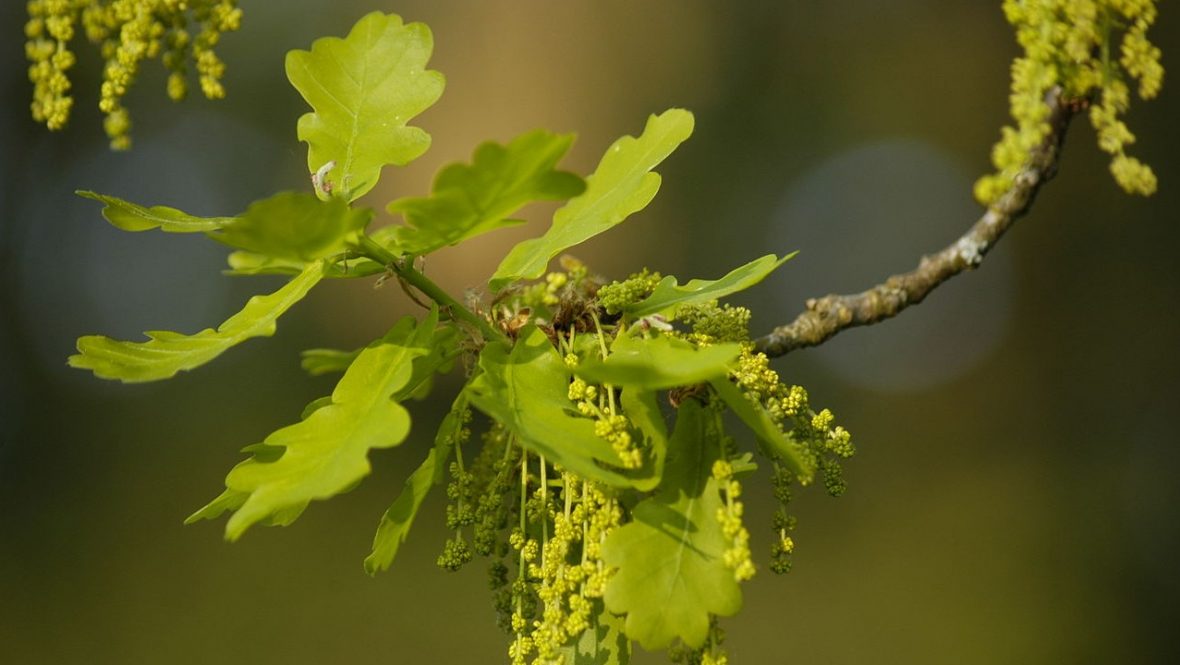
Stieleiche
Stieleiche
Foto: Simon Eugster

STIELEICHE
(Quercus robur)

Eichen (Quercus) sind heutzutage mit ungefähr 400 Arten in Europa, Asien, Nord- und Mittelamerika, der Karibik sowie Nordafrika verbreitet. Mit Kolumbien erreichen sie außerdem gerade noch Südamerika. Somit sind sie eine der wichtigsten Gattungen der Bäume auf der Nordhalbkugel. In Deutschland sind die Eichen nach den Rotbuchen die häufigsten Laubbäume und als Nationalsymbol beispielsweise auf Münzen abgebildet. In Deutschland kommen mit der Stieleiche Q. robur, der Traubeneiche Q. petraea und der Flaumeiche Q. pubescens nur drei heimische Arten vor. Letztere kommt in Mitteleuropa an wenigen isolierten Standorten vor, die wärmebegünstigt sind, wie das Mittelrheintal, der Kaiserstuhl oder das thüringische Saaletal. Sie ist hauptsächlich im nördlichen Mittelmeerraum verbreitet. Trauben- und Stieleiche sind dagegen in ganz Deutschland verbreitet. Die Traubeneiche erreicht mit dem Memelland gerade noch Litauen, während die Stieleiche im Osten noch den europäischen Teil Kasachstans erreicht. In Mitteleuropa kamen im Eozän viele Eichen am Messelsee vor: zehn verschiedene Taxa sind bekannt. Dort wuchsen sie zusammen mit Pflanzen wie Teestrauchgewächsen und Mangos in einem paratropischen Regenwald. Im Eozän kamen Eichen aufgrund des wärmeren Klimas auch am eisfreien Nordpol in Mammutbaumwäldern vor.

PEDUNCULATE OAK
(Quercus robur)

Today, oaks (Quercus) are widespread in Europe, Asia, North and Central America, the Caribbean and North Africa with around 400 species. With Colombia, they also just reach South America. This makes them one of the most important genera of trees in the northern hemisphere. In Germany, oaks are the most common deciduous trees after European beeches and are depicted as a national symbol on coins. In Germany, there are only three native species: the pedunculate oak Q. robur, the sessile oak Q. petraea and the downy oak Q. pubescens. The latter occurs in Central Europe in a few isolated locations that are characterized by warm temperatures, such as the Middle Rhine Valley, the Kaiserstuhl or the Saale Valley in Thuringia. It is mainly found in the northern Mediterranean region. Sessile oak and pedunculate oak, on the other hand, are widespread throughout Germany. The sessile oak just reaches Lithuania with the Memelland, while the pedunculate oak still reaches the European part of Kazakhstan in the east. In Central Europe, many oaks were found in the Eocene at Lake Messel: ten different taxa are known. There they grew together with plants such as tea family plants and mangoes in a paratropical rainforest. In the Eocene, oaks were also found in redwood forests at the ice-free North Pole due to the warmer climate.

3D pollen model: Oliver Wilson provided access to these datathrough the 3D Pollen Project. The files were downloaded from www.MorphoSource.org, Duke University.