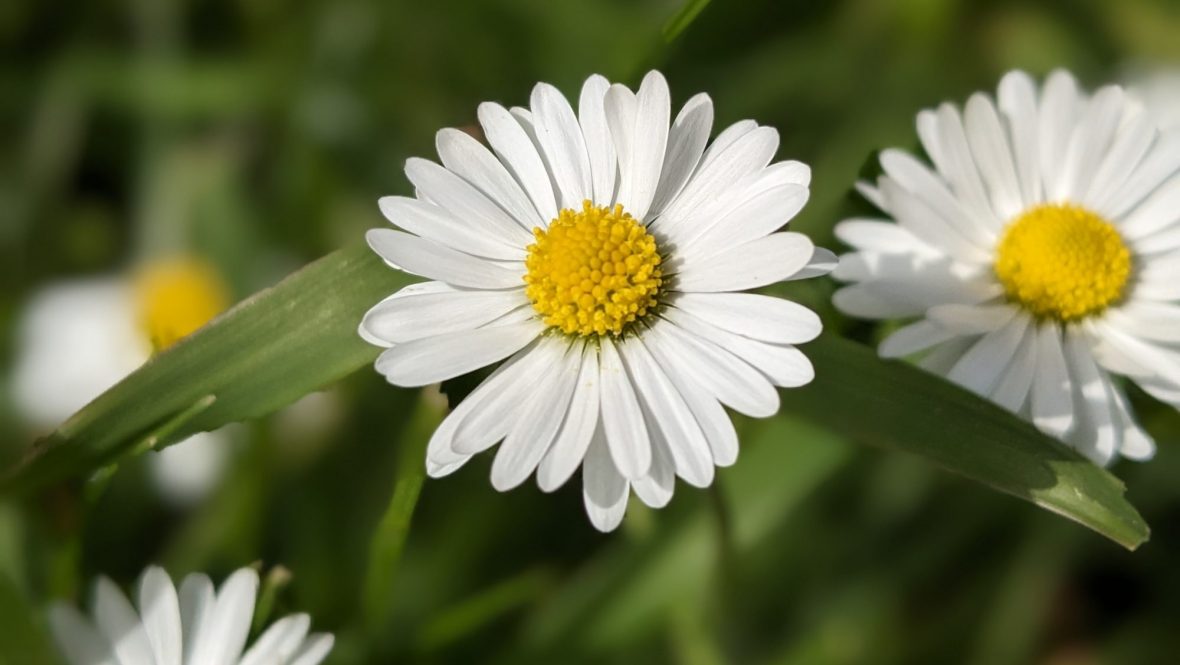
Das Gänseblümchen ist in Mittel-, Nord-, West- und Südeuropa sowie in Nordafrika heimisch. Im Mittelmeerraum gibt es weitere Arten wie das Langblättrige Gänseblümchen und das Einjährige Gänseblümchen. Zur Unterscheidung von diesen wird es dann als Mehrjähriges, Ausdauerndes oder Gewöhnliches Gänseblümchen genannt. Durch die weite Verbreitung und das allgegenwärtige Vorkommen auf nahezu jeder Wiese hat das Gänseblümchen in Deutschland Dutzende von lokalen Namen.
Gänseblümchen sind auf einem der Tore der Mauern von Babylon, welche in der Antike eines der Sieben Weltwunder waren, abgebildet. Dieses Stadttor, das Ischtartor, zu sehen in Berlin, ist in drei Bauphasen nach ca. 600 v. Chr. entstanden. Ältere Darstellungen stammen aus dem Alten Ägypten und Sumer.
Bienen, Hummeln und Fliegen bestäuben die Blüten. Letztere richten sich nach der Sonne und schließen sich vor Sonnenuntergang. Die Samen werden durch Wasser, Wind, Regenwürmer und Rinder verbreitet.

The daisy is native to Central, Northern, Western and Southern Europe as well as North Africa. In the Mediterranean region there are other species such as Bellis longifolia and the annual daisy. To distinguish it from these, it is then called lawn daisy or common daisy. Due to its wide distribution and ubiquitous occurrence in almost every meadow, the daisy has dozens of local names in Germany. Daisies are depicted on one of the gates of the walls of Babylon, which was one of the Seven Wonders of the World in ancient times. This city gate, the Ishtar Gate, which can be seen in Berlin, was built in three phases after around 600 BC. Older depictions come from Ancient Egypt and Sumer. Bees, bumblebees and flies pollinate the flowers. The latter follow the sun and close before sunset. The seeds are spread by water, wind, earthworms and cattle
3D model created by Anthony J. Hayes at the Bioimaging Research Hub of Cardiff University’s School of Biosciences (Core facility RRID: SCR_022556) using methodology as described in Hayes, A.J. (2017) Production of 3D Printed Scale Models from Microscope Volume Datasets for use in STEM Education. EMS Eng Sci J. 2017, 1(1):002. Copyright Hayes, A.J. 2017.
Welterbe Grube Messel gGmbH
Rossdörfer Str. 108
64409 Messel
E-Mail: service@welterbe-grube-messel.de
Tel.: +49 (0) 6159 71759-0